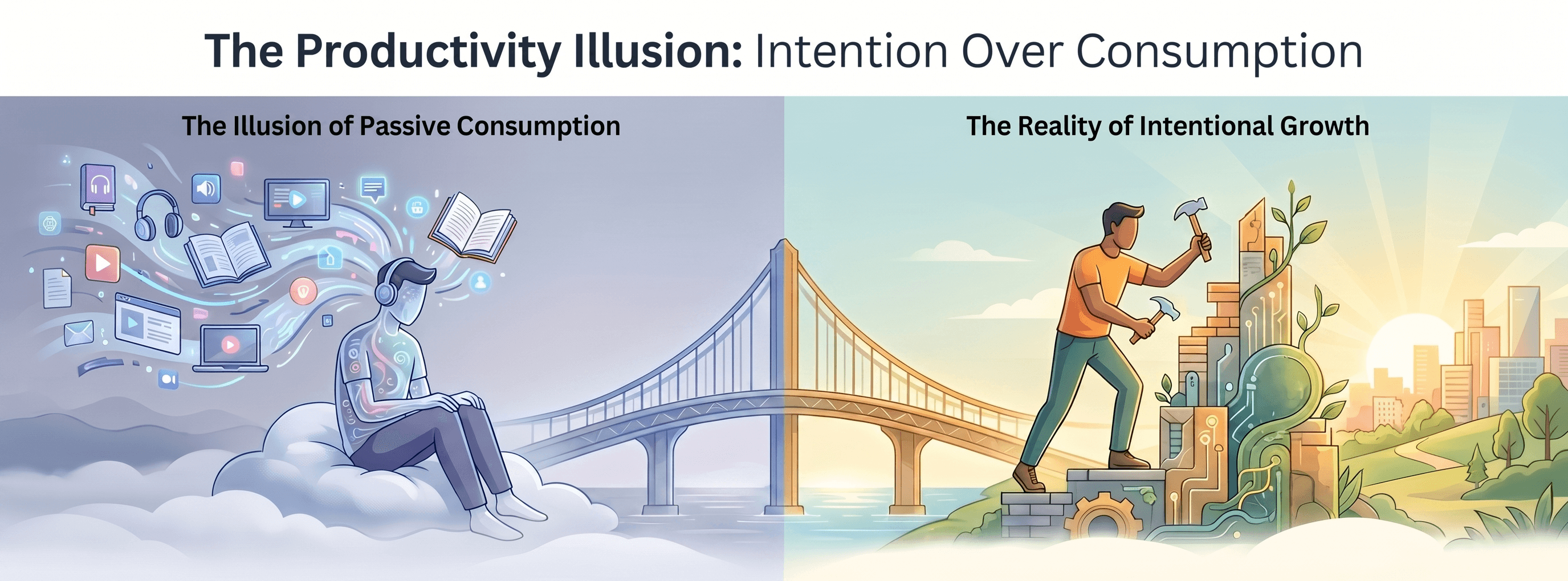
The Productivity Illusion:
Why Consuming More Doesn't Move You Forward
Search for a command to run...
Why Consuming More Doesn't Move You Forward
No comments yet. Be the first to comment.
Trapped in a Digital Echo Chamber
What Shiva and the Bhagavad Gita Teach Us About Love and Action
We’ve all been there. You start a new diet, a new workout routine, or a new creative project with a burst of motivation. For a few days, or maybe even two weeks, you’re unstoppable. And then, suddenly, you’re not. You skip one gym session. You order ...
Kintsugi for the Soul: Why Your Cracks Matter

"Knowledge isn't free. You have to pay attention." - Richard Feynman
A person can finish three audiobooks, complete two online courses, clear 150 emails, and still end the day having created absolutely nothing.
Yet they will often feel productive.
This is one of the most common traps of modern life. We live in a world where information is available instantly and endlessly. Every spare moment can be filled with a podcast, a video, a newsletter, a course, or a book. Because we're constantly consuming something useful, we start to believe we're making progress.
But consumption and progress are not the same thing.
Picture this: you're on your morning commute, headphones in, listening to the latest bestselling non-fiction audiobook at 1.5x speed. By the time you arrive at work, you've checked another item off your self-improvement list.
But how much of it did you actually absorb?
Passive listening can expose you to ideas, but exposure is not the same thing as learning. Learning requires engagement. It requires questioning, reflecting, connecting ideas, and applying them to reality. Without that process, information often passes through our minds as quickly as it entered.
The same principle applies to the endless sea of online courses.
Enrolling in a coding bootcamp, a digital marketing masterclass, or a creative writing workshop feels productive. Watching lesson after lesson gives us the comforting sensation that we're improving ourselves.
But until you open a blank document, write a line of code, publish something, or build a project, nothing has fundamentally changed. Watching someone else do the work is not the same as doing it yourself.
The reason passive consumption is so appealing is simple: it feels like progress without exposing us to failure.
Watching a React tutorial is easier than building a React application.
Reading a book about writing is easier than staring at a blank page.
Listening to a podcast about fitness is easier than going for a run.
Consumption gives us the emotional reward of growth while protecting us from the discomfort of being tested.
Creating something forces us to confront reality. We discover what we don't know. We make mistakes. We struggle. We fail. And because failure is uncomfortable, many of us unconsciously replace action with preparation.
We tell ourselves we're getting ready.
Sometimes we're just hiding.
There is an important distinction that many people miss:
Information changes what you know.
Application changes who you are.
You can read a hundred books about habit formation and still have poor habits.
You can watch fifty hours of programming tutorials and still be unable to build an application.
You can consume endless content about confidence and still avoid difficult conversations.
Information has value, but only when it crosses the bridge into action.
Without application, knowledge becomes little more than trivia.
This illusion extends beyond learning.
Consider the person who spends an entire day responding to emails. Their inbox reaches zero, notifications disappear, and they feel accomplished.
But did they move their most important project forward?
Or did they simply spend eight hours playing digital ping-pong?
Many forms of busyness provide immediate feedback. Emails get answered. Messages get sent. Tasks get checked off. The problem is that these activities often crowd out the deep, meaningful work that actually creates results.
Being busy is not the same as being productive.
In fact, busyness is often the easiest way to avoid doing the deep, difficult work that truly matters.
If productivity isn't about consuming more information or staying busy, what is it about?
Productivity begins with intention.
Doing something productively means engaging with it actively and deliberately.
If you pick up a book because an influencer called it a "must-read," you're simply consuming content. To make that activity productive, you must approach it with curiosity and purpose. Challenge the author's arguments. Take notes. Reflect on the ideas. Ask how they apply to your life.
The goal is not to finish the book.
The goal is to leave the book different from when you started it.
The same principle applies to courses, conversations, meetings, and even entertainment.
Intentional engagement turns activity into growth.
Perhaps the most freeing aspect of this idea is that it removes the guilt surrounding rest.
Not every moment needs to be optimized.
Not every walk requires a podcast.
Not every workout requires a business audiobook.
Not every evening requires a side hustle.
If you want to play a video game, play a video game.
If you want to watch a movie, watch a movie.
If you want to sit quietly and do nothing for a while, do that.
Just be present.
Half-working and half-resting rarely produces great work or meaningful rest. When we're constantly splitting our attention, we end up exhausted without feeling fulfilled.
Intentional leisure is often more restorative than productivity disguised as relaxation.
The next time you find yourself cramming a podcast into a five-minute walk, enrolling in another course you may never finish, or endlessly refreshing your inbox, pause for a moment.
Ask yourself:
Am I paying attention?
Am I engaging with this deliberately?
Or am I simply trying to feel productive?
The goal is not to consume more.
The goal is not to stay busy.
The goal is to act with intention.
Stop performing productivity.
Start creating, learning, resting, and living deliberately.