It is the great paradox of the modern internet: we have access to more data than any generation in human history, yet we are increasingly convinced of things that are entirely wrong.
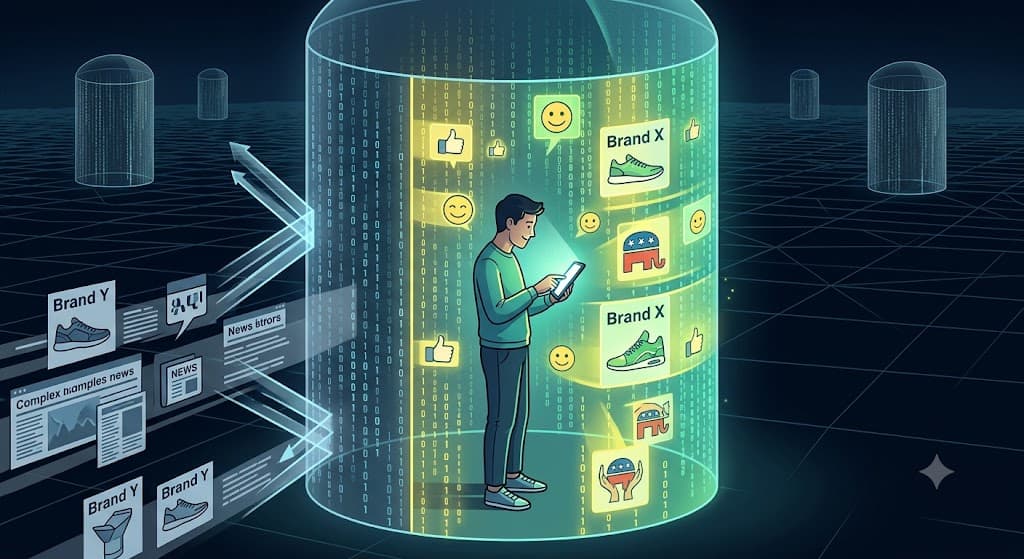
The culprit isn't a lack of information. It's the invisible walls built around us by the platforms we use every day. We are living inside algorithmic silos, echo chambers perfectly designed to reflect our existing beliefs back at us while quietly filtering out the rest of the world.
The Sneaker Illusion
To understand how insidious this is, let's look at a low-stakes example: sneakers.
Imagine two competing shoe companies, Brand X and Brand Y. You buy a pair of Brand X shoes, you "like" a post about them on Instagram, and you watch a quick unboxing video on YouTube.
Instantly, the algorithms driving these platforms take notes. They realize you respond to Brand X. From that moment on, your social media feeds are flooded with content praising Brand X. You see influencers hyping their durability, articles about their cutting-edge design, and a barrage of posts explaining why Brand Y is uncomfortable, overpriced, and flawed.
Here is the catch: Brand Y might objectively make a better, longer-lasting shoe.
But you will never know that. You will never even have the opportunity to consider it. Because your digital environment has convinced you that Brand X is the undisputed king of footwear, and that anyone who prefers Brand Y is simply misguided. You haven't arrived at this conclusion through research or debate; you've arrived there because the algorithm starved you of alternative viewpoints.
If the silo effect only dictated our consumer habits, it would be a marketing problem, a slightly worse version of picking the wrong sneaker. But the exact same mechanism governs how we consume information about political parties, national conflicts, and deeply complex societal issues, and the stakes there are considerably higher than a pair of shoes.
When you show a slight preference for a specific political leaning, the algorithm serves you the most validating, satisfying content related to that view. Simultaneously, it serves you the most extreme, unhinged examples of the opposing side.
This creates a dangerous reality:
The Death of Nuance: Complex issues are flattened into good vs. evil.
The End of Debate: You cannot debate an opposing view if you never actually hear its best arguments. You are only fighting "straw man" versions of the other side.
The Illusion of Consensus: When everyone in your feed agrees with you, you falsely assume the whole world agrees with you.
Without healthy friction, without the challenge of a dissenting opinion, how can anyone know if their stance is actually the right one?
Why the System is Built This Way
It's worth saying plainly: the algorithms aren't malicious; they are just highly optimized. Platforms like YouTube, X, and Instagram aren't run by anyone trying to divide you. They're designed to maximize your "time on site," and it turns out that comfort keeps people on site far better than confrontation does.
Human psychology dictates that we enjoy being agreed with. It releases dopamine. It feels safe. Conversely, encountering information that contradicts our core beliefs causes cognitive dissonance, which feels stressful and unpleasant. The algorithm learns that showing you opposing views might make you close the app, so it wraps you in a warm, comfortable blanket of confirmation bias.
To be fair, the algorithm isn't the only one holding the leash. You choose who you follow, what you mute, and what you scroll past. Most platforms now let you actively curate your feed: block, "see less of this," unfollow. The silo isn't purely something done to you; it's also something you build, one small comfortable choice at a time. That doesn't let the platforms off the hook, but it does mean the walls are at least partly made of bricks we're handing over ourselves, which is actually good news, because it means we have more power to tear them down than a purely deterministic story would suggest.
How to Break the Walls
Escaping the algorithmic silo requires active, intentional effort. I'm not going to sit here and tell you I have all the answers. This is something I've only recently realized myself. But if we want to know what is objectively true, we have to fight the systems designed to keep us comfortable. Here is how we can start:
Audit and systematize your inputs. Look at who you follow. If every single creator, thinker, or news source in your feed shares your exact worldview, you are in a silo. Don't just notice this once. Treat your information diet like any other routine worth building, and check in on it regularly so old habits don't quietly creep back.
Seek out the "Best of the Rest." Find the smartest, most articulate voices on the opposing side of your beliefs and listen to them. Do not look for the loudest voices; look for the most logical ones. Then actually sit with what they say instead of reflexively defending against it. When something immediately makes you defensive, pause and ask: what if they're right? What evidence would it take for me to change my mind?
Bypass the feed entirely. Stop letting a platform dictate what you see. Use RSS readers, or your own custom notification tools and media trackers, to pull updates directly from the sources you choose, entirely bypassing the algorithmic middleman.
Read outside the timeline. The most nuanced arguments rarely fit in a short post or a quick video. Spend time with long-form articles, books, and essays that take the time to deeply explore the gray areas of human behavior and society. It's the same principle as sizing up Brand X and Brand Y properly. You can't judge a shoe fairly from a 15-second unboxing clip, and you can't judge an argument fairly from a 15-second video either.
Information is only powerful if it is complete. Until we actively invite debate back into our digital diets, we aren't learning about the world. We are just staring into a mirror.