The Paradox of Detachment:
What Shiva and the Bhagavad Gita Teach Us About Love and Action
Search for a command to run...
What Shiva and the Bhagavad Gita Teach Us About Love and Action
No comments yet. Be the first to comment.
Trapped in a Digital Echo Chamber

Why Consuming More Doesn't Move You Forward
We’ve all been there. You start a new diet, a new workout routine, or a new creative project with a burst of motivation. For a few days, or maybe even two weeks, you’re unstoppable. And then, suddenly, you’re not. You skip one gym session. You order ...
Kintsugi for the Soul: Why Your Cracks Matter

When most of us hear the word "detachment," we picture someone running away to the mountains. We imagine a cold, emotionless ascetic who has turned their back on relationships, society, and the messy beauty of human life.
But what if our understanding of detachment is entirely backwards?
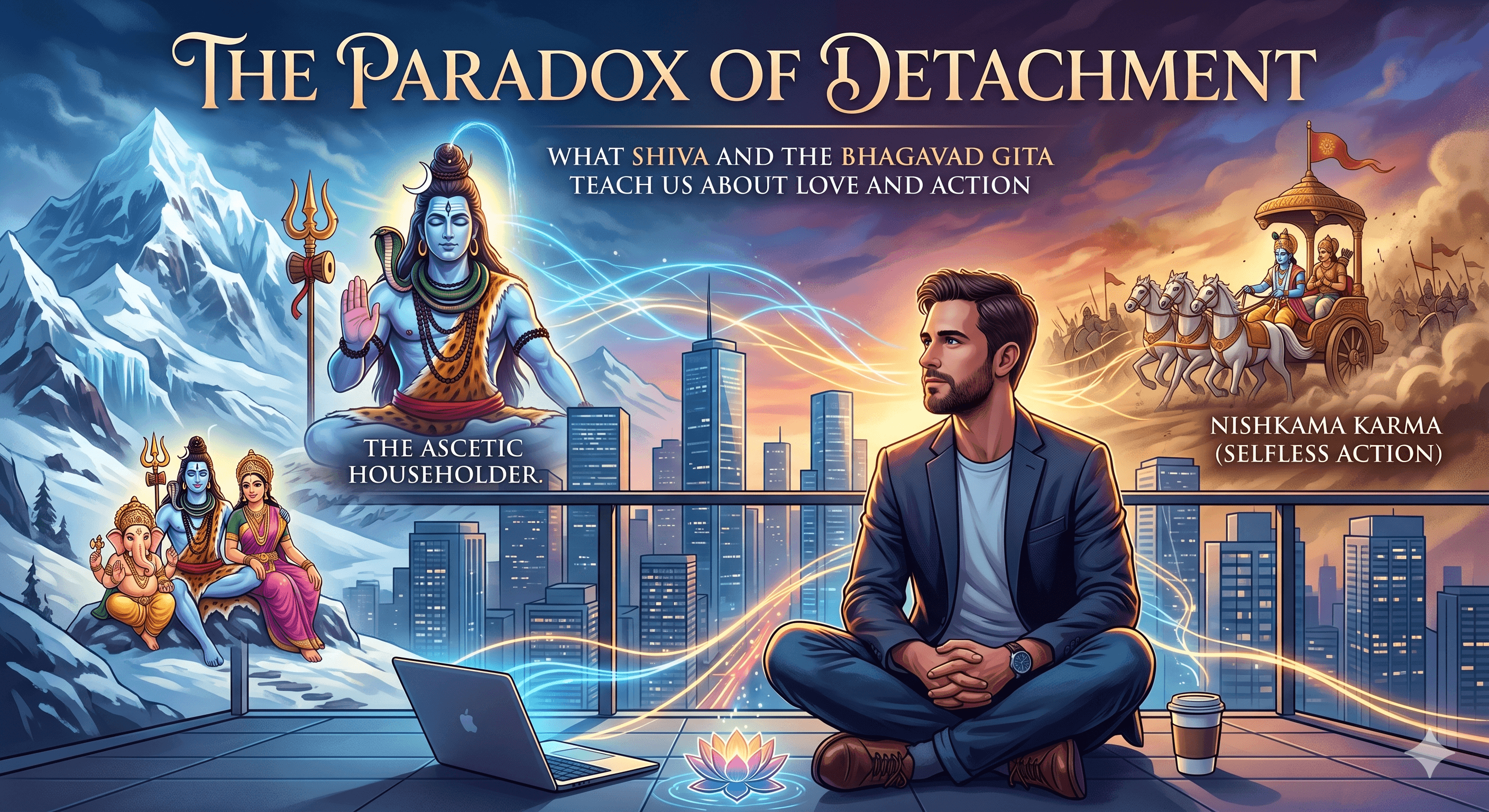
In ancient Indian philosophy, true detachment (Vairagya) isn't about running away from life, it’s about diving into it completely, but without being chained to the outcomes. To truly understand this, we need only look at the striking paradox of Lord Shiva, and how his way of being perfectly mirrors the core teachings of the Bhagavad Gita.
Shiva represents the ultimate cosmic paradox. On one hand, he is the supreme ascetic, meditating in the frozen peaks of Mount Kailash, entirely complete within himself. On the other hand, he is a deeply devoted husband to Parvati and a doting father to Ganesh and Murugan.
How can the ultimate ascetic also be the ideal family man?
The secret lies in the nature of his love. In ordinary human relationships, love often comes with an invisible contract: "I love you, so you must validate me, make me happy, or return my love in equal measure." This is transactional love, driven by the ego's need to be filled.
Shiva’s detachment is a detachment from these ego-driven expectations. He loves Parvati not to get love in return, but because love is his very nature. He doesn't need external validation to feel whole. It is the ultimate emotional freedom: being fiercely, passionately bonded to someone while demanding absolutely nothing from them in return.
This same detachment applies to Shiva's cosmic role as the "Destroyer." Human bias associates destruction with malice, anger, or chaos. But in the cosmic cycle, Shiva destroys because it is a vital necessity, not a personal whim.
Think of a forest fire that clears away dead, decaying brush so that sunlight can reach the soil and new seeds can sprout. Without destruction, the universe stagnates. Shiva shatters the old, the rigid and the toxic, whether it's a cosmic era or our own stubborn egos, so that renewal can happen. He performs this monumental task with absolute detachment. He doesn't destroy out of a desire to ruin; he destroys out of a profound, detached compassion for the cycle of life.
What Shiva embodies as a living state, Lord Krishna explicitly teaches in the Bhagavad Gita on the battlefield of Kurukshetra.
The concept is called Nishkama Karma, selfless action performed without attachment to the fruits of that action. It is famously summarized in Chapter 2, Verse 47:
"You have a right to perform your prescribed duties, but you are never entitled to the fruits of your actions."
Krishna’s brilliant psychological framework perfectly breaks down the way Shiva lives:
You control the effort, not the outcome: You can pour your entire soul into a relationship, a creative project, or your career. But the final result depends on countless variables outside your control.
Expectations breed anxiety: If you are constantly looking over your shoulder to see if your partner is loving you back "enough," or if your boss is going to praise your project, you are no longer present. You are living in a hypothetical future, and suffering inevitably follows.
Never default to inaction: Krishna warns that letting go of the outcome does not mean you get to be lazy. You must still act with absolute intensity and dedication.
By synthesizing the mythology of Shiva with the philosophy of the Gita, we uncover the ultimate blueprint for modern living.
Detachment is not the opposite of love or action. It is the very thing that purifies them. When we stop demanding that our partners, our jobs, or the world validate our existence, we are finally free. We can love our families profoundly, do our work masterfully, and engage with the world passionately, not because of what we can extract from it, but simply for the joy of the doing.
That is the true art of detachment: caring more than ever, while needing nothing in return.